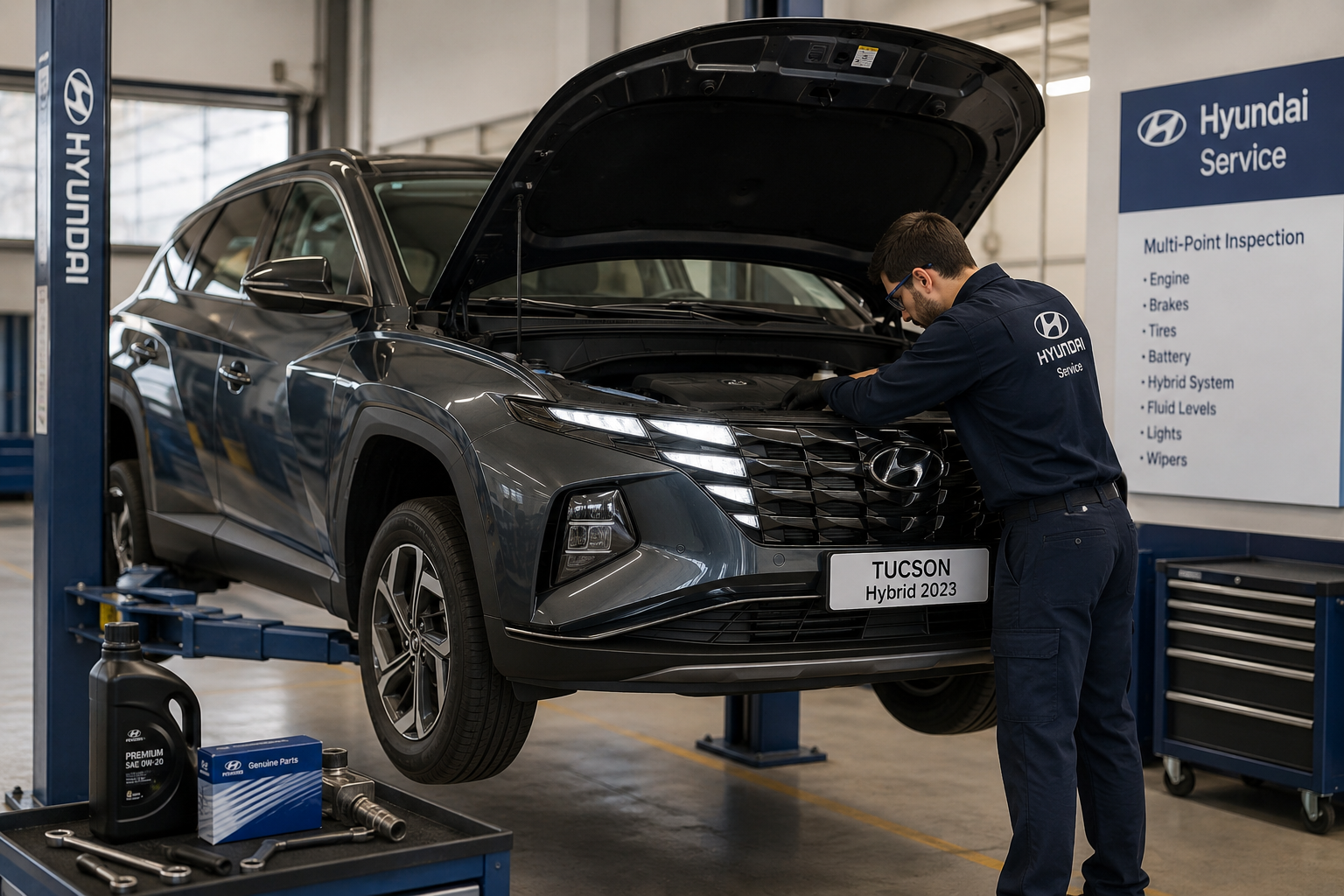

Real Case Study | Hyundai Tucson NX4 2023 | 1.6 T-GDi Hybrid Engine | Automatic Transmission
Picture this: you're on the motorway, you press the accelerator for an overtake, and suddenly the car seems to have lost all interest in going fast. Warning lights flood the dashboard, the engine response goes sluggish, and the car locks itself at 50–60 km/h. If you own a 2023 Hyundai Tucson and this sounds familiar, you've just experienced what's known as limp mode — or emergency/fail-safe mode.
That's exactly what happened to the owner of a 2023 Hyundai Tucson NX4 hybrid, who turned to CarMedic AI for an initial diagnosis. The results were delivered in under a minute, covering 7 possible causes ranked by severity and probability. Let's break down everything you need to know — from the car's technical specs, to the root causes of the problem, and why the AI diagnosis worked so well.
The fourth-generation Hyundai Tucson (internally codenamed NX4) was launched in 2020 and received a facelift in 2023, retaining the same technical DNA while visibly refining the onboard software and driver assistance systems.
It is one of the best-selling compact SUVs in Europe, praised for its bold "Parametric Dynamics" design language and its wide range of electrified powertrains.
| Engine | Type | Power | Transmission |
|---|---|---|---|
| 1.6 T-GDi | Turbocharged petrol | 150 hp | 6-speed manual / 7-speed DCT auto |
| 1.6 T-GDi MHEV | 48V Mild Hybrid | 180 hp | 7-speed DCT auto |
| 1.6 T-GDi HEV | Full Hybrid | 230 hp | 6-speed 6AT auto |
| 1.6 T-GDi PHEV | Plug-in Hybrid | 265 hp | 6-speed 6AT auto |
The vehicle in our case study is the Full Hybrid (HEV) or Mild Hybrid (MHEV) variant with a 1.6 T-GDi 1598cc engine and automatic transmission — one of the most popular configurations in the European market.
No car is perfect. The Tucson NX4 is generally reliable, but has a few documented vulnerabilities:
The owner of the 2023 Tucson noticed a worrying pattern: under sharp acceleration, the car would lose power and enter limp mode. Dashboard warning lights would illuminate, throttle response would become minimal, and the accessible top speed would drop dramatically.
What exactly is limp mode?
Limp mode (also called fail-safe or emergency mode) is a protective mechanism triggered by the ECU (Engine Control Unit) when it detects an anomaly that could damage critical components. In practice, the car "limits itself" so it can reach a garage without sustaining major damage. It's a clear signal that something isn't working correctly and that technical intervention is needed.
After entering the symptoms into the CarMedic AI platform, the system generated a full report within seconds, including possible causes, severity levels, and confidence scores. Here's what it identified:
1. Engine Electrical System Fault — 65% confidence
A faulty alternator, loose electrical connections, or voltage sensors reporting incorrect values can disrupt ECU operation and trigger limp mode. In a hybrid vehicle, the electrical system is even more complex, involving both the 12V network and the high-voltage battery network.
2. Hybrid Battery Issue — 60% confidence
The high-voltage hybrid battery is the "heart" of the drivetrain on a Tucson HEV/PHEV. If the battery cannot supply or absorb the required energy — due to cell degradation, a faulty BMS (Battery Management System), or extreme temperatures — the ECU automatically activates limp mode as a protective measure.
3. Automatic Transmission Fault — 60% confidence
The 6AT (or 7-speed DCT, depending on variant) can trigger limp mode if the ATF temperature sensor reports overheating or if internal hydraulic pressure drops below the optimal threshold.
4. Fuel Supply System Issue — 80% confidence (most probable cause)
A clogged fuel filter or a fuel pump working at the edge of its capacity cannot deliver the required flow during a hard acceleration event. In a hybrid engine that rapidly switches between energy sources, any fuel deficit is immediately detected by the ECU.
5. Faulty MAF (Mass Air Flow) Sensor — 75% confidence
The MAF sensor measures the mass of air entering the engine and is essential for calculating the correct air-fuel ratio. A dirty or faulty MAF sensor sends incorrect data to the ECU, which will restrict injection and limit power to prevent the engine from running outside safe parameters.
6. Faulty Throttle Position Sensor (TPS) — 70% confidence
The TPS communicates to the ECU how far the driver is pressing the accelerator. If the signal is intermittent or incorrect, the ECU cannot properly coordinate injection, ignition, and the hybrid system — resulting in delayed responses and entry into limp mode.
7. Exhaust System Issue — 70% confidence
A partially clogged catalytic converter or a slow-responding lambda sensor can create excessive back-pressure and report emissions values outside the norm, causing the ECU to reduce engine output.
This is perhaps the most important question. Why use an AI diagnosis instead of simply calling a garage?
1. Speed and Accessibility
An AI diagnosis provides an initial assessment in seconds, anytime and anywhere. No need to wait for a service appointment, leave the car, or drive anxiously to a mechanic.
2. Causes Ranked by Probability
CarMedic AI doesn't offer a generic list of possibilities — it ranks them by probability and severity, based on the symptoms entered, the exact vehicle model, and its technical specifications. The owner knows exactly where to start the investigation.
3. Model-Specific Context
The system is aware of the technical characteristics of the Tucson NX4 hybrid — including the documented vulnerabilities of hybrid versions regarding oil contamination, the 48V battery, or the MAF sensor. It's not a generic diagnosis — it's tailored to your specific car.
4. Immediate Action Guidance
The report also included a clear recommendation about driving safety: short distances to a garage only, no motorway driving or high speeds. This simple piece of information can prevent a far more expensive breakdown.
5. Lower Diagnostic Cost
CarMedic AI's estimate for diagnosis and repair: €100–€300, with a labour time of 2–4 hours. The owner walks into the garage informed, knowing what to expect — and far less likely to be surprised by an inflated quote.
Based on the AI diagnosis, we recommend following these steps in order:
The CarMedic AI diagnosis for this 2023 Hyundai Tucson NX4 didn't fix the problem itself — that remains the job of a qualified mechanic. But it transformed a stressful, costly situation into a clear, informed, and controlled process.
The owner now knows what to look for, in what order, with what approximate budget, and whether the car is safe to drive to a garage. That's real power in the hands of the driver.
If you're experiencing similar symptoms — or simply want to know what's going on with your car before heading to a garage — try CarMedic AI and get an instant, model-specific diagnosis.
This article is based on a real diagnosis generated by the CarMedic AI platform for a 2023 Hyundai Tucson NX4 with a 1.6 T-GDi hybrid engine and automatic transmission. Technical information about the model comes from verified public sources (Hyundai Motor, NX4 technical documentation).

Diagnoza auto AI
CarMedic AI© . All Rights Reserved.